
Posted by Stephen Deuel on 29th Apr 2026
What Business Insider Got Right (and Missed) About Vibroacoustic Therapy
Note: This post is commentary on a Business Insider article published April 29, 2026. I'm not a physician, and nothing here is medical advice or a treatment claim. I'm writing as someone who has spent 25+ years in vibroacoustic therapy.
A 24-year-old Business Insider reporter spent five hours at a San Francisco biohacking event this month, testing every longevity technology she could get her hands on. Neurofeedback. IV drips. Red light therapy. Cold plunge. Infrared sauna. Biological age testing.
One experience stopped her cold.
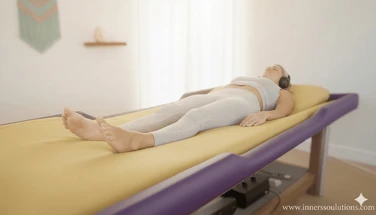
A vibrating sound bed.
"The first time the bass hit and the vibrations went rippling through me, the biggest smile spread across my face. It felt like my body was melting into the mattress."
Of every longevity tool at the event, the sound bed was the one she singled out as her standout experience. She didn't have the language for what was happening to her. She described it as music, as luxury, as relaxation. But her body knew.
If you've spent any time on a vibroacoustic table, you know exactly what she felt.
What she got right
The reaction is real, and it's universal. I've watched skeptics, clinicians, athletes, trauma survivors, and curious first-timers lie down on a vibroacoustic table for the first time. The smile she described? I see it almost every time. The body recognizes something it's never been taught to expect: sound it can feel, not just hear.
That's not marketing. It's physiology. When low-frequency vibration meets soft tissue, fascia, and bone, the nervous system shifts in ways you can measure. Heart rate variability changes. Breathing slows. Sympathetic tone drops. The body isn't being entertained. It's being regulated.
Where vibroacoustics fits in the biohacking stack
Biohacking is, at its core, about self-regulation through measurable, non-pharmaceutical, daily-use interventions. Look at what's in the standard stack: cold plunge, red light, breathwork, HRV training, sauna, sleep tracking, neurofeedback. Most of those are either stressor-based (cold, heat, intense breath protocols) or cognitive (neurofeedback, meditation apps).
There's a gap on the parasympathetic side. Most biohacking tools train you to handle stress better. Few of them deliver deep, measurable downregulation passively, while you simply lie still.
That's where vibroacoustic therapy lives. It's the recovery counterpart to the stressor stack. You aren't earning the response through discipline or discomfort. The response happens because low-frequency sound, delivered through the body, directly modulates the autonomic nervous system. HRV climbs. Vagal tone rises. The system shifts toward rest, repair, and integration.
And unlike many biohacking tools, the experience is genuinely pleasant. That matters more than people give it credit for. The most sustainable daily practice is the one you actually want to do.
What she missed
The bed she tried, a $2,650 product called the Crescendo, uses transducers built into a foam mattress. It's a real introduction to the modality, and the company that makes it deserves credit for putting vibroacoustic technology in front of a mainstream audience.
But she walked away thinking she'd tried the technology. What she really tried was an entry point.
After 25 years building vibroacoustic equipment and using a table myself every morning, I can tell you the experience scales considerably from there. The physics of why matter.
Foam absorbs vibration. Water transmits it.
That's the simplest way to explain why a water-based vibroacoustic table feels fundamentally different from a foam sound bed. Foam has air pockets that dampen low-frequency energy before it reaches the body. Water is roughly 800 times denser than air and nearly incompressible, so it carries those frequencies through to every point of contact at once. You're not lying on a vibrating surface. You're lying in a resonant medium that surrounds you.
The reporter described the bass bed as feeling like her body was melting into the mattress. On a water-based table, the vibration doesn't push, it blooms. People more often describe feeling like the boundary between body and sound has dissolved entirely. Same direction, different magnitude.
Her real objection
She closed her review of the bed with a line worth taking seriously:
"There are too many free ways to relax to justify spending so much on a vibrating sound bed."
She's right, if vibroacoustic therapy is a relaxation product. There are plenty of free ways to relax. Walks, breathwork, a good night's sleep, a bath.
But that framing misses what the technology actually does, and it's the framing the longevity press is going to keep getting wrong until practitioners speak up.
Vibroacoustic therapy has been studied in peer-reviewed clinical settings since the 1980s. The published research touches pain reduction (particularly fibromyalgia, lower back pain, and post-surgical recovery), anxiety and PTSD symptom reduction, sleep onset and quality, autonomic regulation, Parkinson's symptom modulation, and cognitive and arousal changes in non-responsive patients. You can review the studies we draw on here.
That's not a relaxation tool. It's a therapeutic modality. The right comparison isn't bath salts and meditation apps. It's biofeedback, hyperbaric oxygen, and HRV training. Modalities people pay for because of what they do, not because they're a pleasant way to spend an hour.
The bass bed at a Silicon Valley pop-up didn't have a clinical frame. The technology she tried does. Most of the press coverage just hasn't caught up yet.
Why this matters
Business Insider just put a vibroacoustic experience in front of the exact audience that's been buying biohacking and longevity equipment for the last decade. The category has been validated in mainstream media. The next conversation is depth: water vs. foam, therapeutic protocols vs. relaxation novelty, clinical research vs. wellness aesthetic.
If you've used one of our frequency tracks at home, or experienced a session in a clinic, you already know what the reporter was feeling. You also probably know there's more to it than what she experienced.
That's the part the longevity press is going to spend the next year catching up on. We've seen the cycle before. Every few years a new audience discovers vibroacoustics, calls it a luxury, then slowly figures out it's something else entirely.
We're glad they're paying attention. We just want them to get the full story.
If you're curious how water-based vibroacoustics differs from foam-based systems, see Why Water Transmits Vibration Better Than Foam and Why Water-Based Vibroacoustic Tables Feel So Different to the Nervous System. For a look at how I personally use vibroacoustics alongside red light and meditation every morning, see Sound, Light, and Stillness: My Morning Practice on the Liquid Sound Table. To explore the table itself, visit the InnerSoul Tranquility Liquid Sound Table.
#vibroacoustictherapy #biohacking #longevity