
Posted by Stephen Deuel on 14th Apr 2026
Sound, Light, and Stillness: My Morning Practice on the Liquid Sound Table
Note: This post shares my personal daily practice. I'm not a physician, and nothing here is medical advice or a treatment claim. I'm writing as someone living with a progressive neurological condition who has built a sustainable morning routine around the tools I know best.
The Backstory
I've been designing and building Liquid Sound Tables since the late 1990s. I'm 71, and I still go to the shop every day to handcraft them. Walking my 82-foot shop many times a day is part of what keeps me moving.
I've been building these tables for a long time. This isn't something I recommend from a distance. It's something I live with and use myself.
About seven years ago, I was diagnosed with a progressive peripheral neuropathy. The formal picture today is bilateral sensorimotor polyneuropathy, progressive, symmetric, and after a thorough workup by neurology, classified as idiopathic. Fifteen vials of blood ruled out the treatable causes. Serial EMG studies from 2019, 2024, and 2026 show the progression clearly.
My feet feel like I'm walking on river rocks. My legs feel wrapped, heavy. I get occasional electric shocks and spasms and burning in my feet. I've learned to pace myself: work, rest, work again. I've also learned that the daily practice I've built around sound, vibration, light, and stillness is part of what keeps me functional.
This post is about that practice. Over the years, people have asked me what I actually do day to day, not in theory, but in practice. This is that answer.
What I Do Each Morning
I spend 90 minutes to 2 hours on my Liquid Sound Table most mornings. Inside that window, three things happen at once:
Vibroacoustic therapy. I run VAT frequency tracks through the table. The low-frequency sound travels through the water and into the body, resonant, full-body, and deeply settling. (Playlist details below.)
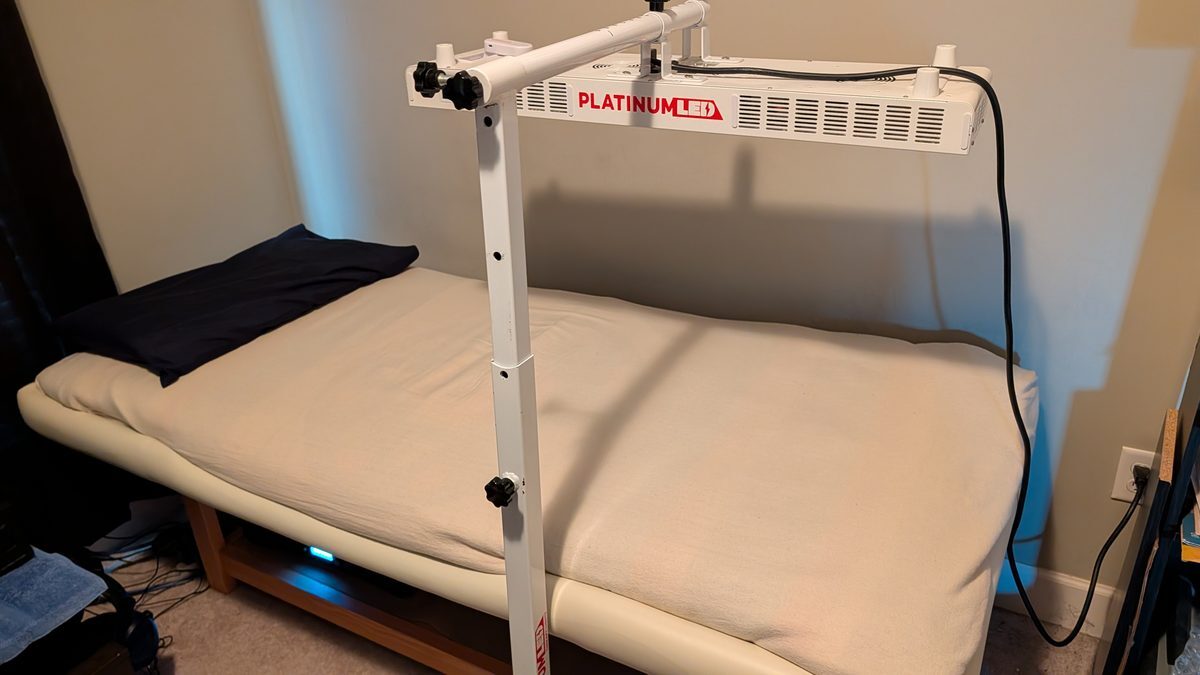
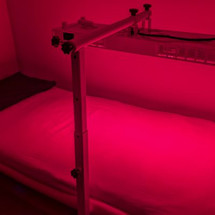
Red and near-infrared light. I use a PlatinumLED panel positioned 18 inches above the body, 40 minutes total, split between front and back. Twenty minutes on the front of the lower body, twenty minutes on the lower back down to the toes. Each side is 10 minutes red, 10 minutes near-infrared. That protocol is deliberate: red light works closer to the surface, circulation and tissue, while near-infrared penetrates deeper, reaching the kind of tissue where peripheral nerves actually live. For someone whose neuropathy runs from the lumbar spine to the feet, covering that full posterior chain matters. That dosing and distance is where I've landed after experimenting over time, and it's where I've stayed.
Meditation. I meditate for 20 minutes while I'm on the table with the lights running. The table does the work of getting my nervous system into a parasympathetic state. Meditation rides on top of that.
The combination is the whole point. Each piece could stand on its own, but together they stack. The table is the foundation of that stack. It's what allows the sound to be felt through the body in a consistent, repeatable way, and it's what ties everything else together.
Why I Built It This Way
I'm not looking for a miracle. With progressive idiopathic neuropathy and seven years of EMG data, I'm realistic about what's possible. What I'm doing is supporting the nervous system in the state where it does its best maintenance work: parasympathetic, calm, well-circulated, well-rested.
- Sound and vibration settle the nervous system and shift autonomic tone.
- Red/near-infrared light supports circulation and cellular energy in the tissues where I need it most.
- Meditation trains how my nervous system processes signal, including the signal from my legs.
I also walk my shop daily, I've been doing weekly PT for core and balance for over a year, I see a low-force chiropractor weekly, and I work with my neurology team. The morning practice doesn't replace any of that. It sits underneath it.
I don't use OTC or prescription pain medications. This practice, along with the PT, chiropractic, and neurology support, is what I actually rely on.
What the EMG Tech Said
Last time I had an EMG, the physician doing the study was surprised I wasn't in more pain. My findings looked, on paper, like they "should" hurt more than they do. I don't know exactly why that is. I suspect it's some combination of staying active, building a practice that keeps my nervous system regulated, and showing up to it every day for a lot of years.
I'll take it.
My Morning Playlist
I start with Inner Alignment – Creating Coherence, a track developed from the tuning fork frequencies I've used in chakra work for decades. Chris encoded those specific frequencies into the recording so the table delivers them as vibration. It establishes a sense of whole-body coherence before moving into the more anatomically focused work that follows. I also play it every night at bedtime on a 20-minute sleep timer — it carries me a few minutes into the next track before shutting off, and in the morning I pick up right where it left off. The practice doesn't really start and stop. I wake up inside it.
The rest of the playlist is a sequence of Inner Soulutions frequency tracks organized anatomically, moving through the body from the spine outward to the peripheral structures where I carry the most load:
Inner Alignment – Creating Coherence
Establishes a sense of coherence before moving into more localized work
Spinal Frequencies
Works through the central column where structural and neurological load is carried
Neck and Shoulders
Addresses upper-body tension patterns that affect posture
Pelvic Support Frequencies
Supports the base structure where stability begins
Sciatica
Targets the main nerve pathways from the lower back into the legs
Sciatica 2
A complementary variation working the same pathways differently
Piriformis Muscle Frequency
Focuses on a key muscle influencing sciatic nerve compression
Hip Frequencies
Supports a primary weight-bearing joint and common restriction point
Knee and Feet Frequencies
Moves into the lower chain where balance and movement are expressed
Calf Vibroacoustic Frequencies
Targets the calf muscles directly, an area of significant load and symptom expression with peripheral neuropathy
Eleven tracks. On a full session I run the whole queue. That's where the 90 minutes to two hours comes from. The sequence moves through the body in a way that makes sense to me, starting centrally and working outward into the areas where symptoms tend to show up. The table delivers all of it as vibration, felt in the body, not just heard.
Most of these tracks are part of the Muscle & Structural Series — available as a bundle or individually on the VAT Frequencies & Music page.
Why I'm Sharing This
I'm sharing this because people ask me what I actually do, and because I think the honest version is more useful than the marketing version. I'm not claiming the Liquid Sound Table, the light panel, or the meditation is going to regrow nerves or reverse a progressive condition. I am saying that building a sustainable, enjoyable daily practice has been part of how I keep working, keep building tables, and keep showing up for my family and my shop.
If you're navigating something chronic and progressive, or just looking for a morning anchor, I hope some of this is useful.
Explore the Tools
If you're curious how this feels in practice, or how people are using these systems in real settings, you can explore our Liquid Sound Tables and VAT Frequencies & Music.
And if you're working with something of your own, the most important piece is simply finding a routine you can stay with, something that supports you over time, not just in the moment.
As always, talk with your own clinicians about what makes sense for your situation.