
Posted by Stephen Deuel on 5th Mar 2026
What Happens in Your Body During Vibroacoustic Therapy?
Estimated reading time: 5 minutes
For many people, the first experience on a vibroacoustic table is surprising.
They lie down expecting to simply hear music or feel a gentle vibration. Instead, something deeper begins to happen. Breathing slows. Muscles start to soften. The mind quiets. Some people even fall asleep within minutes.
I’ve been building and working with vibroacoustic tables for more than 25 years, and I’ve had the opportunity to observe thousands of sessions. While every person’s experience is different, certain patterns appear again and again.
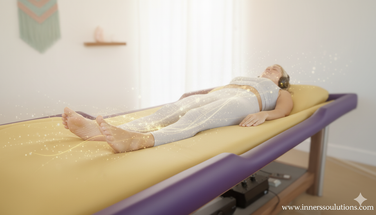
From the outside, it may look like someone simply resting on a table.
But inside the body, several things are happening at once.
Vibroacoustic therapy delivers low-frequency vibration directly through the body, creating a whole-body listening experience that can influence muscles, breathing, and the nervous system.
Understanding what the body is doing during a vibroacoustic session can help explain why these experiences often feel so different from ordinary relaxation techniques.
- Vibroacoustic therapy delivers low frequency vibration directly through the body.
- Mechanoreceptors in the skin and muscles respond to rhythmic vibration.
- The nervous system often shifts toward a parasympathetic “rest and restore” state.
- Breathing, heart rate, and muscle tension may begin to synchronize with rhythmic sound.
- Water based vibroacoustic tables distribute vibration more evenly across the body.
The Body Is Receiving Mechanical Vibration
At its most basic level, vibroacoustic therapy delivers low frequency mechanical vibration through the body.
Unlike airborne sound that you hear through your ears, these frequencies are transmitted physically through the surface you are lying on. When delivered effectively, the vibration travels through tissues, muscles, and fluids in the body.
Because the human body is largely composed of water and soft tissue, vibration can move through it quite efficiently. When the delivery system allows vibration to spread evenly, the experience tends to feel smooth and immersive rather than localized or buzzy.
Many people describe the sensation not as something “pushing into” the body, but as something surrounding or enveloping it.
Mechanoreceptors Are Being Stimulated
Embedded throughout the skin, muscles, and connective tissue are sensory receptors called mechanoreceptors. These receptors respond to physical pressure and vibration.
When low-frequency vibration reaches these receptors, they send signals through the nervous system that influence how the body organizes tension, posture, and awareness.
Different types of mechanoreceptors respond to different kinds of stimulation:
- Some respond to gentle pressure and slow movement
- Others respond to deeper vibration and rhythmic input
- Still others contribute to the body’s sense of spatial orientation
This constant stream of sensory information helps the brain update its understanding of what the body is doing and where it is in space.
When the input is smooth and predictable, the nervous system often interprets it as safe sensory information.
The Nervous System Begins to Shift
One of the most noticeable effects during vibroacoustic sessions is the shift in the autonomic nervous system.
Many people arrive in a state of mild activation due to the everyday stress of modern life. Muscles may be slightly tense, breathing shallow, the mind busy.
As the body receives consistent, rhythmic vibration, the nervous system often begins to reorganize.
Breathing becomes slower and deeper.
Muscles release held tension.
Mental activity quiets.
In many cases, this reflects a shift toward parasympathetic activity; the “rest and restore” side of the nervous system.
This transition is not forced. Instead, the body often settles into it naturally when the sensory environment supports relaxation.
If you’d like a deeper explanation of why water based vibroacoustic tables often feel more settling for the nervous system, you can read it here: Why Water-Based Vibroacoustic Tables Feel So Different to the Nervous System.
Muscles and Fascia Begin to Let Go
Another change many practitioners notice during sessions is muscle softening.
Low frequency vibration can influence both muscle tissue and the fascia that surrounds it. When vibration is distributed evenly through the body, muscles often release small amounts of holding tension.
This is not the same as aggressive mechanical massage. The change tends to be more gradual — a slow unwinding rather than a forced release.
Practitioners frequently observe that areas of long-held tension may soften over the course of a session, particularly when the person feels safe and comfortable.
Rhythms in the Body Begin to Synchronize
The body is full of rhythms; breathing, heart rate, neural activity, and muscle firing patterns.
When rhythmic sound and vibration are introduced, the body sometimes begins to synchronize with those rhythms, a process often referred to as entrainment. For example, a slow pulsing vibration may naturally encourage slower breathing. As breathing slows, heart rate often follows, and the nervous system may shift further toward relaxation.
As these internal rhythms begin to organize, the body may move toward a more coherent state, where multiple systems are working together more smoothly.
In practice, this is often the point where people notice their breathing deepen, their muscles soften, and their attention turn inward.
This is one reason vibroacoustic sessions frequently feel both calming and immersive.
Emotional Processing Can Sometimes Occur
Because the nervous system and emotional regulation are closely connected, some people experience emotional responses during vibroacoustic sessions.
This can range from a simple sense of relief to moments of reflection or emotional release.
When the body feels supported and safe, it sometimes allows experiences or tensions that have been held for a long time to move or reorganize.
Not every session produces emotional responses, and that isn’t the goal of the work. But it is a natural possibility when the nervous system shifts into a more regulated state.
Why the Delivery System Matters
While frequencies themselves are important, how vibration reaches the body is equally important.
Different materials transmit vibration differently.
Foam, for example, tends to absorb and dampen energy. Rigid surfaces may concentrate vibration in specific areas.
If you want the mechanics of that difference, here’s a deeper explanation: Why Water Transmits Vibration Better Than Foam.
Water behaves differently. Because it is fluid and dense, it distributes vibration evenly across the body’s surface. This allows sound energy to travel more smoothly through the body rather than remaining localized.
This even distribution often contributes to the sense of immersion people describe during sessions.
A Whole-Body Listening Experience
Ultimately, vibroacoustic therapy invites the body into a different kind of listening.
Instead of hearing sound only through the ears, the entire body becomes part of the experience. Muscles, connective tissue, and sensory receptors all participate in how vibration is received and interpreted.
For many people, this creates a state that feels both deeply relaxing and quietly alert, a kind of whole body awareness.
A Process That Unfolds Over Time
Every person’s experience with vibroacoustics is different.
Some people relax immediately. Others take a few sessions before the body learns to settle into the experience. Practitioners often find that regular sessions allow clients to access deeper states of relaxation over time.
What remains consistent is the body’s remarkable ability to respond to rhythm, vibration, and sound when they are delivered in a supportive way.
After more than two decades working with vibroacoustics and building these systems, that capacity still fascinates me.
Related Articles
Curious to Experience It Yourself?
In practice, how vibration is delivered to the body matters just as much as the frequencies themselves.
If you're curious how this process feels beyond descriptions, you can learn more about the Liquid Sound Table — Sound You Can Feel and how water-based vibroacoustics are used in both professional and personal settings.
Explore the Liquid Sound Table
If questions come up, that page also offers the option to schedule a brief discovery call. No pressure — just clarity.